Neoclassicism Brings What Period of Art Forward to This Period of Time?
Galleries
A Cursory History of Neoclassical Art
Neoclassical fine art: its evolution, Classical inspiration, and significant artists.

"The only manner for us to become peachy, or fifty-fifty inimitable if possible, is to imitate the Greeks."
—Johann Joachim Winckelmann
As the term implies, neoclassicism is a revival of the classical past. The move began around the middle of the 18th century, marking a time in fine art history when artists began to imitate Greek and Roman artifact and the artists of the Renaissance. Apart from Diderot, other art critics desired a "better" kind of art that followed the styles of past masters similar Nicolas Poussin (French, 1594–1665), Michelangelo (Italian, 1475–1564), and Raphael (Italian, 1483–1520) who were very much influenced by the classical world.
Johann Joachim Winckelmann, founder of modern archaeology and art history, praised the Greeks and believed them to be every bit close to perfection equally possible. Post-obit Winckelmann's words, many artists began to report Greek compages and create classically inspired works of art. In 1738, excavations of Pompeii and Herculaneum led to the finding of well-preserved, colorful paintings, mosaics, and pottery. These discoveries only fueled artistic fascination and curiosity for antiquity, and artists began to use this new noesis of the past in their art, creating their own "new" classical style that was extremely different from the Rococo—a fashion popular during the early on to mid-18th century.
I such artist was Jean-Auguste-Dominique Ingres (French, 1780–1867). His painting of Oedipus and the Sphinx (1808) represents a scene from the classical Greek plays of Sophocles. Oedipus, the protagonist of the plays, finds himself face to face with a Sphinx, who asks him the now-famous riddle: Information technology walks on 4 legs in the morn, two in the afternoon, and three in the evening. Bated from the subject matter drawing inspiration from Greek culture, the physical characteristics are traditionally classical: beauty, harmony, balance, and line. The use of strict horizontal and vertical lines, conspicuously seen in Oedipus's stance, is a very of import neoclassical characteristic that helps create a harmonious and balanced limerick. Though Ingres's epitome of Oedipus does not portray the idealized man form essential to classicism, his depiction of the male figure agrees with Winckelmann'due south idea of "imperfect nature." Perfection lies inside the imagination, and the image one creates in reality is only the thought of perfection.
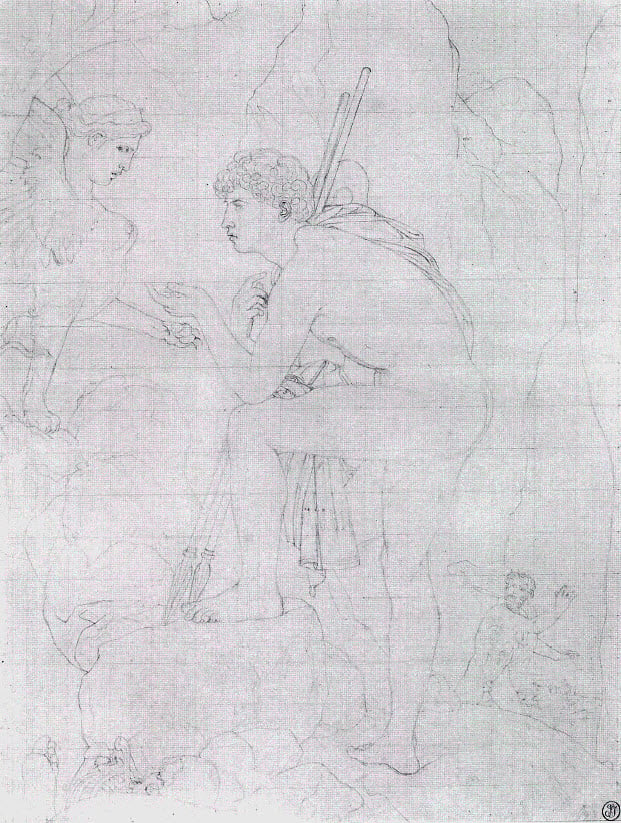
Jean-Auguste-Dominique Ingres, Oedipus Before the Sphinx, pencil, sold at Christie'due south London
The discovery of preserved ancient artifacts also played a huge role in the Decorative Arts of the time. Josiah Wedgwood (British, 1730–1795), ane of the most famous English ceramic manufacturers of the 18th century, founded the Wedgwood company in 1759, which produced classically inspired jasperware, creamware, and black basalts, formed using simple geometric lines, and decorated with frieze-like scenes reminiscent of ancient Greek and Roman pottery. John Flaxman (British, 1755–1826), a prominent neoclassical sculptor, illustrator, and designer, began working for Wedgwood effectually 1775. His oeuvre includes illustrations for classical literature like the Odyssey, and designs for classically inspired decorative works of art produced by Wedgwood, and monuments for armed forces heroes and nobles.
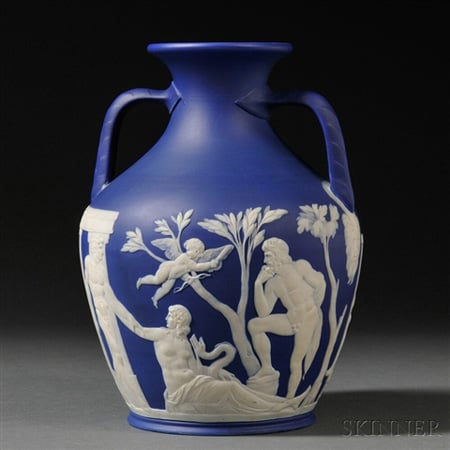
Wedgwood Dark Blueish Jasper Dip Portland Vase, c.19th century, sold at Skinner, Boston, MA
John Flaxman, A Pair of Wedgwood Blue and White Jasperware Rectangular Plaques, c.1795–1800, sold at Sotheby's New York
Neoclassicism was as well an important movement in America. The United states of america modeled itself on the ancient civilizations of Rome and Greece, both architecturally and politically. Neoclassical ideals flowed freely in the newly formed republic, and classically inspired buildings and monuments were erected. Washington, D.C. is even so busy with these white marble façades, imitations of antiquity, and portraits of presidents sculpted in the manner of Roman emperors and glorified in colossal monuments.
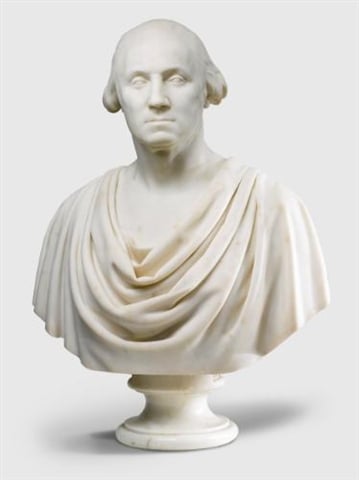
Hiram Powers, Bust of George Washington, marble, sold at Sotheby's New York
Follow Artnet News on Facebook:
Want to stay alee of the fine art world? Subscribe to our newsletter to become the breaking news, middle-opening interviews, and incisive critical takes that bulldoze the conversation forward.

Source: https://news.artnet.com/market/a-brief-history-of-neoclassical-art-32742
0 Response to "Neoclassicism Brings What Period of Art Forward to This Period of Time?"
Post a Comment